
Legal minds under pressure: the mental health crisis among lawyers

The legal profession, often idealised as a path to prestige and influence, conceals a harsh reality: its practitioners face one of the highest rates of mental health issues across industries. According to this survey, 36% of lawyers report problematic alcohol use, and 28% struggle with depression. Anxiety affects 19% of attorneys, and nearly one in four associates experience burnout within the first five years of practice.
These numbers echo global mental health trends, with 76% of employees reporting a mental health condition (HHS), and 1 in 10 struggling with depression (WHO). Yet, the intensity of legal work, marked by high stakes, adversarial dynamics, and long hours, further amplifies these challenges.
Unique stressors in the legal industry
Lawyers operate in an environment of constant scrutiny, high expectations, and adversarial conflict. The competitive nature of the profession fosters a culture where having a mental health issue is seen as a liability. This often leads attorneys to hide mental health struggles, fearing professional repercussions. For example, untreated anxiety or depression may result in diminished productivity, strained client relationships, and even ethical lapses, posing risks not just to the individual but also to their firms.
The pressure to meet billable hour requirements and maintain profitability adds another layer of stress. Associates, in particular, grapple with long hours, isolation, and relentless workloads, while partners bear the weight of maintaining client trust and the firm's reputation. For women and minority lawyers, systemic inequities exacerbate the issue. Although mental health outcomes for these groups have improved recently, disparities in support and representation persist, highlighting an urgent need for equitable wellness initiatives.
Breaking the stigma
The stigma surrounding mental health in the legal profession is deeply ingrained. Lawyers often hesitate to seek help, equating it with weakness, a perception reinforced by the adversarial nature of their work. This avoidance leads to a cycle of untreated issues that can escalate into severe personal and professional consequences.
Addressing this stigma requires cultural change within the profession. Prominent law firms are beginning to implement measures such as providing mental health support, and fostering respectful, inclusive work environments. However, the shift also needs to come from individual attorneys, who need to view mental health care as a tool for personal and professional resilience.
How HappierMe can help
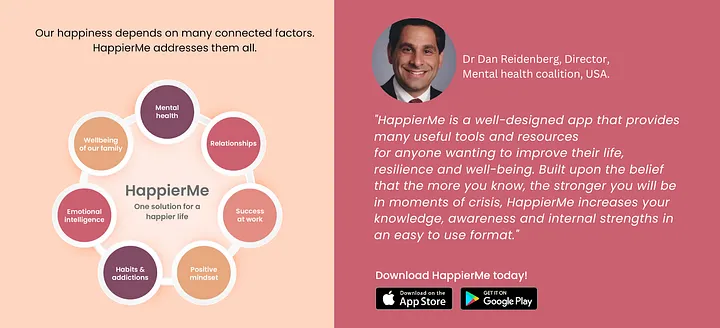
HappierMe is a personal development digital platform that helps users feel better now, and empowers them to develop their emotional intelligence and apply that to lead a happier life.
HappierMe recognises the unique challenges faced by lawyers and offers tailored solutions to support their mental wellbeing.
It helps users feel better through guided meditations, journaling, and breathing exercises. It then empowers people to develop their self-awareness and emotional intelligence to manage their own mental health, have happier relationships, deal with addiction and develop their communication and leadership skills.
What makes it stand out is that it addresses the root cause, not just the symptoms, for lasting change. Preventing mental health problems is so much easier.
Just as we go to the gym to look after our physical health, HappierMe offers a daily routine of breathing exercises, self-reflection, and journaling to look after our mental health.
The separate section for teenagers allows lawyers to also ensure the wellbeing of their family.
With 75+ modules and a host of features including an online journal, a forum for peer support, an extensive library of podcasts, meditations and videos, it's a one-stop solution for a happier life.
Toward a healthier legal community
The mental health struggles in the legal field are not insurmountable. By prioritising awareness, reducing stigma, and promoting holistic solutions like HappierMe, the legal profession can evolve into a space where success and wellbeing coexist. This transformation requires collaboration among firms, professional bodies, and individual lawyers. Only then can the industry truly support its members, ensuring that those who advocate for justice are also empowered to advocate for themselves.
Also read
1. HappierMe
Website
2. 6 ways to transform organisations
3. Reducing workplace conflict and boosting collaboration
4. Self-awareness helps leaders succeed
5. How to manage your own mental health
6. Subscribe to our
newsletter
7. Follow us on
social media
8. Join our
Facebook group
and
LinkedIn Group
Understand your mind. Live a happier life.
Life can be tough. The HappierMe app is your personal guide to help you feel better now, but also to take you deeper to understand your thoughts and feelings. It supports you to become the person you want to be, to be happier, manage your emotions and succeed in the world. There are also coaches you can speak to through the app.
About us
Get HappierMe
Support


Copyright © 2024 HappierMe. All rights reserved
Copyright © 2024 HappierMe. All rights reserved


