
Mental health struggles among corporate employees

Corporate employees face some of the highest levels of mental health challenges across industries. 76% of employees report experiencing a mental health condition (HHS), 1 in 6 struggle with a substance use disorder (CDC), and 1 in 10 suffer from depression (WHO).
Furthermore, 38% encounter workplace conflict (CIPD), intensifying workplace stress and its effects on wellbeing. Corporate environments are particularly affected due to their demanding nature, with long hours, performance pressures, and job insecurity being common contributors.
The corporate mental health crisis
The mental health struggles of corporate employees are exacerbated by systemic factors inherent to the sector. A survey from the WHO reveals that high workloads and a lack of flexibility are common stressors among corporate employees, contributing significantly to burnout, a condition now classified as an occupational phenomenon.
Additionally, nearly 15% of working adults globally experience mental disorders such as anxiety and depression, which are worsened by workplace conditions.
The fast-paced nature of corporate jobs often leads to chronic stress, sleep deprivation, and strained relationships, all of which fuel mental health problems. For instance, findings indicate that employees in high-stress roles are at a heightened risk of substance use disorders, which are often a coping mechanism for excessive work pressure.
The stigma around seeking help for mental health issues in professional settings further compounds the problem, preventing employees from accessing necessary support.
Industry-specific challenges
Corporate employees face unique challenges compared to other sectors. The rise of hybrid and remote work models has blurred boundaries between personal and professional lives, fostering a culture of being "always available."
This has led to significant increases in feelings of isolation and loneliness, with over 25% of employees reporting a decline in their social connections during remote work transitions.
Workplace dynamics, including micromanagement and lack of autonomy, also contribute to stress. According to recent WHO and ILO findings, inadequate managerial support is a leading factor in poor mental health outcomes in corporate employees.
Moreover, the competitive environment in corporate settings fosters job insecurity, which is linked to heightened anxiety levels and decreased job satisfaction.
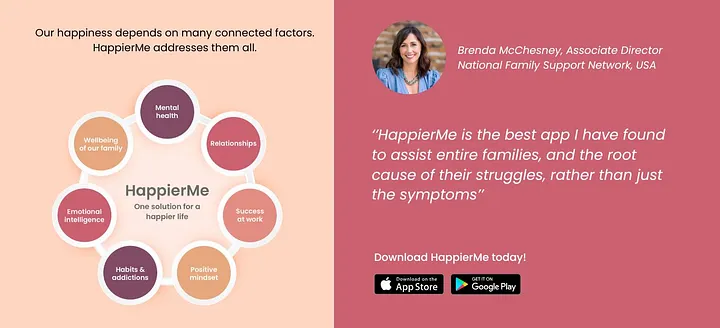
Fighting back: the HappierMe difference
HappierMe is a personal development digital platform that helps users feel better now, and empowers them to develop their emotional intelligence and apply that to lead a happier life.
HappierMe recognises the unique challenges faced by employees and offers tailored solutions to support their mental wellbeing.
It helps users feel better through guided meditations, journaling, and breathing exercises. It then empowers people to develop their self-awareness and emotional intelligence to manage their own mental health, have happier relationships, deal with addiction and develop their communication and leadership skills.
What makes it stand out is that it addresses the root cause, not just the symptoms, for lasting change. Preventing mental health problems is so much easier.
Just as we go to the gym to look after our physical health, HappierMe offers a daily routine of breathing exercises, self-reflection, and journaling to look after our mental health.
The separate section for teenagers allows workers to also ensure the wellbeing of their family.
With 75+ modules and a host of features including an online journal, a forum for peer support, an extensive library of podcasts, meditations and videos, it's a one-stop solution for a happier life.
Prevention is so much easier
Prevention of mental health and relationship problems is so much easier than trying to solve the problem once it has occurred.
HappierMe offers proactive prevention solutions by helping people to have a calm mind and empowering them to develop their self-awareness and emotional intelligence, so they can be in charge of how they think, what they think, how they feel and how they act in the world. It empowers people to be in charge of their own happiness, self-regulate their own emotions, habits and mental health and have happier relationships.
Conclusion
The statistics surrounding corporate mental health struggles highlight a growing crisis that demands immediate attention. By understanding the unique stressors faced by corporate employees and implementing systemic changes, organisations can take significant strides toward improving workplace wellbeing. Tools like HappierMe, combined with organisational commitment, can pave the way for a future where mental health is not just addressed but actively supported in every workplace.
Also read
1. HappierMe
Website
2. 6 ways to transform organisations
3. Reducing workplace conflict and boosting collaboration
4. Self-awareness helps leaders succeed
5. How to manage your own mental health
6. Subscribe to our
newsletter
7. Follow us on
social media
8. Join our
Facebook group
and
LinkedIn Group
Understand your mind. Live a happier life.
Life can be tough. The HappierMe app is your personal guide to help you feel better now, but also to take you deeper to understand your thoughts and feelings. It supports you to become the person you want to be, to be happier, manage your emotions and succeed in the world. There are also coaches you can speak to through the app.
About us
Get HappierMe
Support


Copyright © 2024 HappierMe. All rights reserved
Copyright © 2024 HappierMe. All rights reserved


